In June 2020, TOPFLOOR asked if CGI was the new normal, particularly when lockdown prevented in-real-life photoshoots. But now, a year on, we wonder if the design and product industry will follow the art world and embrace the newest technology trend… Mixed Reality.
What is Mixed Reality?
Mixed Reality blends the physical and virtual world by allowing us to interact with both real-life and digitally created objects at the same time. It is more advanced than Virtual Reality, which immerses you in a digital experience, and Augmented Reality, which overlays virtual images onto the real-world environment, but the virtual cannot interact with the real.
Mixed Reality can be experienced through holographic devices (like a projector) or immersive Virtual Reality devices (like a headset).
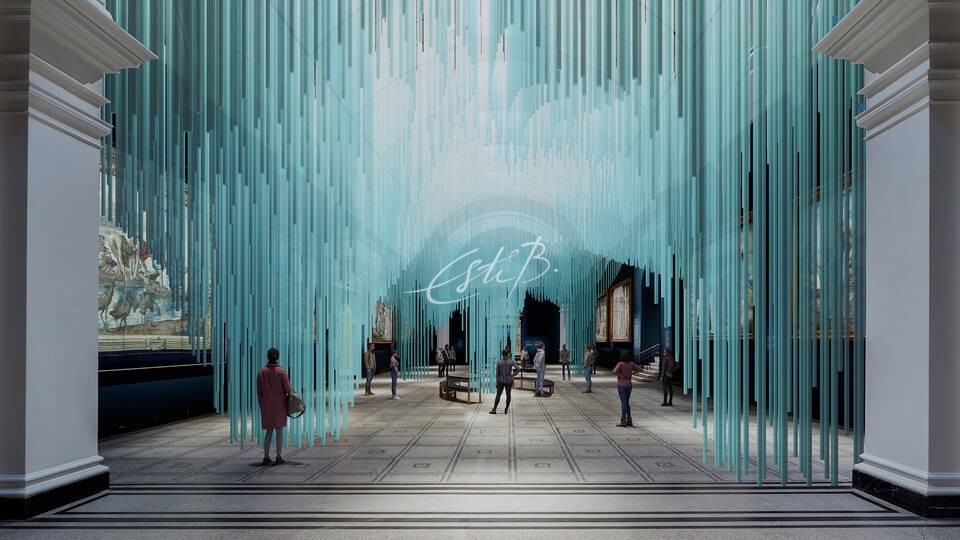
VICTORIA & ALBERT MUSEUM. MEDUSA: ARCHITECTURE + REALITY
Museums and galleries are slowly but steadily embracing Mixed Reality experiences. Most recently, London’s Victoria and Albert Museum hosted a Mixed Reality installation as part of LONDON DESIGN FESTIVAL in September 2021 – MEDUSA: ARCHITECTURE + REALITY showed natural and architectural features that “slowly morph and evolve based on movement in the space”, to illustrate the connection between life, designed space and climate change. The installation was created in a collaboration between Japanese architect Sou Fujimoto and Mixed Reality studio and developers TIN DRUM. TIN DRUM also produced artist Marina Abramović’s Mixed Reality performance THE LIFE at Serpentine Galleries in 2019.

SERPENTINE GALLERIES. MARINA ABRAMOVIC: THE LIFE. VIA CHRISTIE’S
How can designers utilise Mixed Reality?
The potential uses of Mixed Reality for those who design, buy and sell textiles or furniture are huge. Through a Mixed Reality device, we could step into a showroom or tradeshow stall on the other side of the world and browse through their offerings. We could look closely at samples virtually and immediately – instead of waiting for days, if not weeks or months, for the items to arrive. Alternatively, we could open the doors of our own Mixed Reality showroom to anyone across the globe, without the need for real space, transport, security or insurance.

MIXED REALITY STORE. VIA MICROSOFT
Instead of video calling on ZOOM, we could hold Mixed Reality meetings with workshops to oversee the production of our designs in real-time. Carmaker Mercedes-Benz is already using Mixed Reality to provide specialist help for mechanics fixing complex engine problems.
We could virtually test out new rugs and carpets in our homes before we buy. While current Augmented Reality apps on your smartphone can place a textile over a floor or wall, Mixed Reality might have the ability to be even more sophisticated, like trialling what a textile might look like draped over a sofa or a bed. This will be much faster, and perhaps more affordable, than relying on talented CGI designers to create mocked-up images. A picture may be worth a thousand words, but nothing can replace being in the space.

WOODSCAPE RUG. CGI: AD ARCHITECTURE
Admittedly, Mixed Reality cannot yet provide the ability to handle or feel an item, and the texture of a rug or carpet can be as important a consideration as its colours or patterns. But we believe it will only be a matter of time before the technology is advanced enough.
As the ‘new normal’ becomes more and more digital, Mixed Reality might be the newest opportunity to enhance and improve traditional design and product industry practices. Watch this space.